Manual vs automation testing: which does your team actually need?
Manual or automated testing? It's not either/or. Here's a practical breakdown of when each earns its place — and why, whichever you use, the bugs they find need one shared home your team can work from.

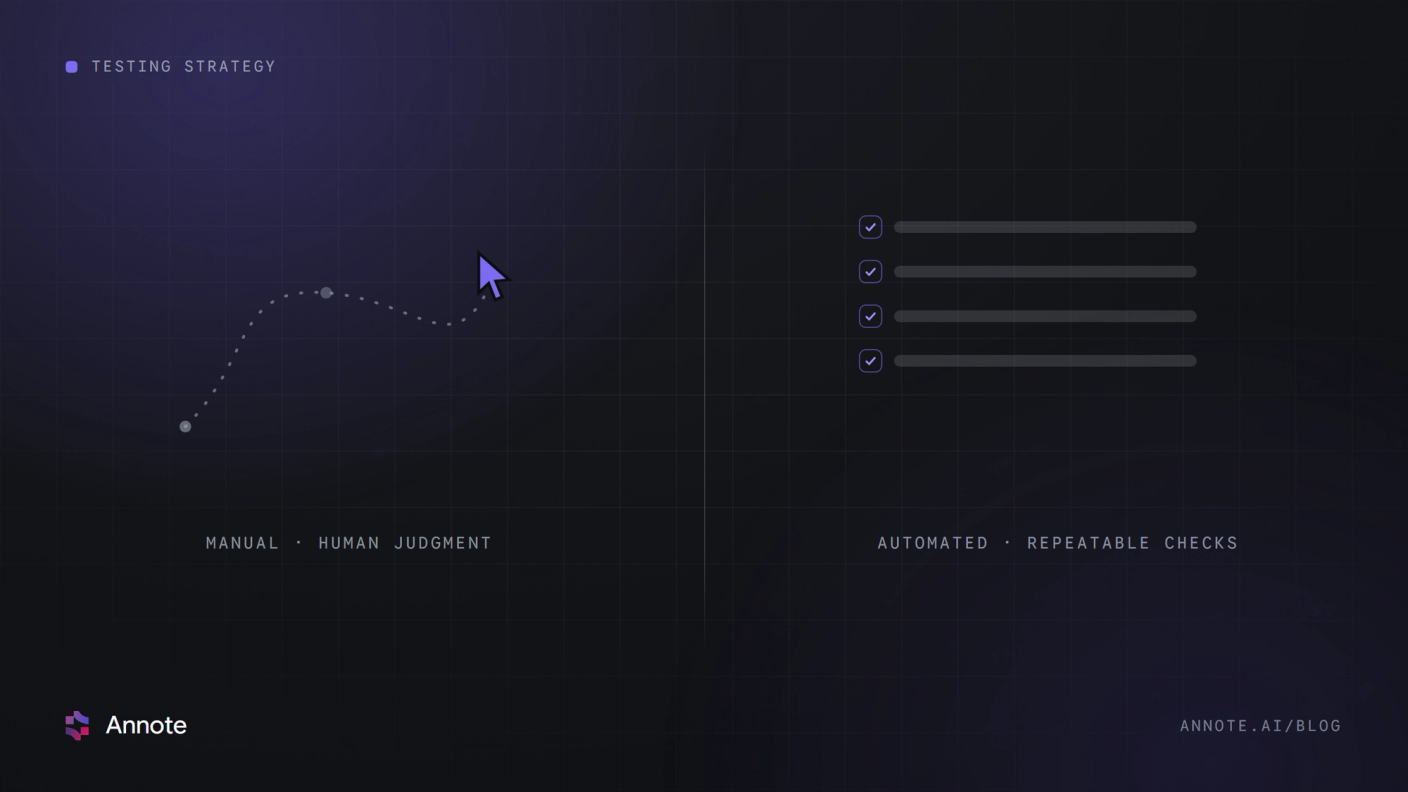
"Should we do manual or automated testing?" is slightly the wrong question. The two aren't rivals; they're tools for different jobs, and most healthy teams use both. Here's a practical breakdown — and a note on what they share, which is where a lot of teams actually lose time.
What manual testing is good at
Manual testing means a human using the product — clicking, exploring, noticing. It shines at:
- Exploratory testing — following a hunch to the weird edge case no script covers.
- Usability and visual judgment — whether a layout feels broken or a flow is confusing.
- New, fast-changing features — where writing automation would be wasted effort.
Tradeoff: slow to repeat, hard to scale, inconsistent across runs.
What automation testing is good at
Automated testing means scripts running checks for you. It shines at:
- Regression testing — re-running the same checks every release so nothing silently breaks.
- Scale and speed — thousands of checks in minutes across browsers.
- Consistency — the same thing every time, no fatigue.
Tradeoff: expensive to build and maintain, brittle when the UI changes, blind to what nobody thought to check.
When to use each
- Automate the stable, repetitive, high-value paths — login, checkout, core flows — that must never break.
- Test manually the new, the exploratory, and the "does this feel right" work that needs judgment.
Use automation as the safety net and manual testing as the human eye. They cover each other's blind spots.
What both have in common — and where teams lose time
Here's the part that gets overlooked: whether a bug comes from a manual pass or a human reviewing a failed automated run, someone has to report it and the whole team has to act on it. If those bugs scatter — a stack trace in the CI log, a note in Slack, a screenshot in email — your QA process stalls no matter how good your testing is. (We dig into that failure mode in why scattered bug reports slow your team down.)
The fix is a shared home for what testing finds. When every bug (manual or automated) lands in one collaborative session — captured with full context, then assigned, prioritized, discussed, and resolved together — your testing effort actually turns into shipped fixes instead of a scattered backlog. That's the workflow Annote gives teams: one organized, collaborative place for the bugs your testing surfaces.
 Ishaq Javed